

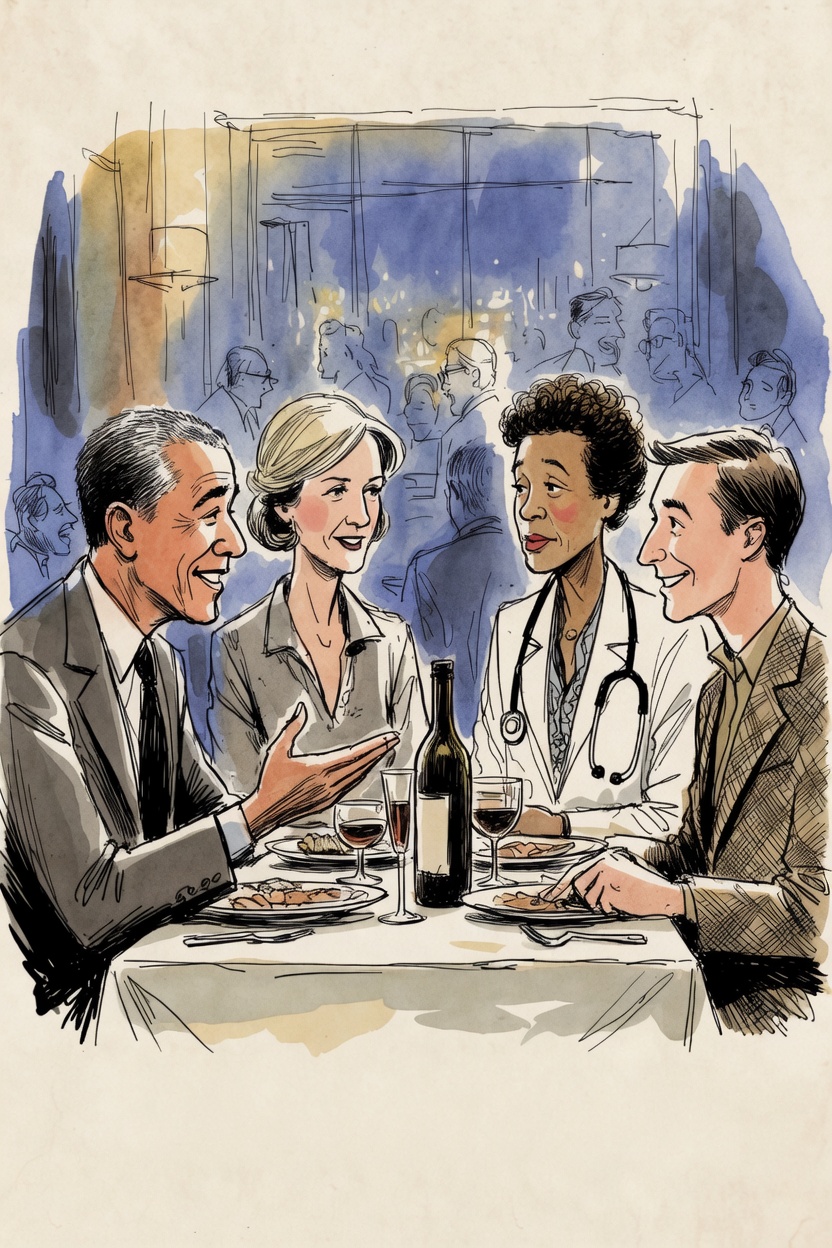
“We ate at a restaurant,” Keith said. “Me, the President, the First Lady, and Dr. Lee.”
Keith was my new patient, and I needed to thoroughly review his medical records. He suffered from acute respiratory distress, nighttime fevers, and frequent complaints about his kidneys. The treatment Dr. Lee had prescribed was merely short-term—easing symptoms but not addressing the root cause. That wasn’t a major issue, though. I’m a seasoned professional, a doctor with a comprehensive knowledge of over two thousand drug compositions, their patent names, and the pharmaceutical companies behind them. This is thanks to my habit of asking Bob to buy me the latest edition of the PDR—the Physician’s Desk Reference—every year to stay current with new medications.
“Alright, Keith, unbutton your shirt.”
Keith was slow to respond, so I had to repeat myself, louder this time.
“Sorry, Doc,” he said. “I was still thinking about my dinner with the President.”
“You’re always thinking about it. You’re always eager to talk about it.”
Keith unbuttoned his shirt, but he undid every single button.
“Keith, you don’t need to unbutton all of them. Two buttons are enough.”
“Oh, okay, sorry, I understand.”
Keith apologized constantly—for this, for that. I couldn’t quite grasp what he felt he’d done wrong to others. Fortunately, I’m a professional, always patient with the non-medical grievances my patients share. You’d be surprised how often just listening to their complaints, paired with a bit of advice, can speed up their recovery.
“So, what did you eat with… our President?” I asked, stifling a chuckle as I said “our President.”
“You’re laughing, Doc.”
“No, I’m not.”
“Yes, you are.”
“Okay, Keith. I was laughing. My apologies.”
“You’re always apologizing, Doc.”
“Quiet, Keith. I can’t hear your heartbeat.”
“Sorry, Doc.”
I checked his heart; the rhythm was steady and strong, though the stethoscope was pinching my ears uncomfortably.
“Now open your mouth wide.”
Keith opened his mouth so wide I was hit with a wave of foul breath.
“Stick out your tongue and say ‘AAA.’”
He complied. I shone my small flashlight into his mouth, nearly gagging at the smell. I noticed one upper molar and two lower ones with cavities; Keith’s tongue looked pale and shriveled. I paused to think. It could be typhoid. But my instincts leaned toward something stranger, like the odd diseases cropping up lately—COVID-19 or bird flu, perhaps.
Keith mumbled something incoherent, gesturing toward his mouth.
“Hold on, Keith,” I said. “I’m thinking.”
He nodded.
Diagnosing a patient… it’s hard, you know, it has to be perfect, I have to be sure, always sure. He should understand that.
“Okay, you can close your mouth now.”
“Thanks, Doc,” Keith said. “What’s wrong with me?”
“I’m not sure yet. Now lie down.”
I pressed on the left side of his abdomen. “Does this hurt?”
“No, that part’s fine.”
“Tell me if anything hurts.”
My hands moved to the center of his stomach, pressing gently, then up a bit, pressing harder.
“Ow, that hurts, Doc. I—I can’t breathe.”
I returned to my desk, deep in thought. A lab test to confirm? Probably not. I was certain it was a virus, not bacteria, so no antibiotics were needed. A vaccine? Unnecessary.
I mentally sorted through a list of oral medications, then wrote out a prescription, including what Dr. Lee had previously prescribed, plus vitamins and an appetite stimulant. Keith was painfully thin.
“Keith?” I called. “Come here.”
He hopped off the exam table like a child. “What’s up, Doc? Am I okay?”
“Sit down.”
I’m a Harvard-trained cardiologist, but since setting foot in this hospital, I’ve worn many hats. This hospital—a supposedly top-tier facility in Chicago—has deplorable resources. It was Christmas Eve, and every other doctor was celebrating with their families. Not me, of course. I was here, devoted to my patients, alongside my two junior colleagues in the ER. In an hour, I’d perform an appendectomy, then visit the TB ward. In every case, I found myself doubling as a psychiatrist.
“What did you write, Doc?”
“Your prescription.”
“No shots?”
“No, nothing to inject. Can you be quiet, Keith? You don’t want me to write the wrong prescription, do you?”
“No, Doc. I’ll be still as a statue.”
Keith froze like an actual statue, making me feel a pang of guilt.
“You haven’t told me about your dinner with the President.”
“Well, Doc, the President ordered food for me. He asked if I liked steak, and I said I love steak. You know, Doc, I love all food.”
“So, what did you eat?”
“Tuna steak.”
“You ate tuna steak?”
“The President had tuna steak, too. It was delicious, Doc. You should try it.”
“The President doesn’t eat steak. He’s a vegetarian, like me.”
“No, Doc. The President ate tuna steak. He said it was the best in Chicago. I loved the sauce. So did he.”
“You’re mistaken, Keith. The President doesn’t eat meat. Neither do his wife or their three children. He’s raised his family to live healthily. You know, meat is full of parasites. Parasites cause disease. I learned that at Harvard.”
“But fish isn’t meat, Doc. The President ate tuna steak. He finished it and almost ordered more, but he noticed the reporters around him.”
“Aha! Clever, Keith, but not clever enough. Do you have proof the President ate steak? You mentioned reporters. Can you show me the article?”
“No, Doc. I don’t have the paper.”
“So you admit I’m right and you’re wrong.”
“You’re right, Doc. I’m wrong. My bad.”
“You’re always apologizing, Keith.”
I tore off the prescription and handed it to him. He studied it for an eternity.
“You don’t need to stare at it. Just give it to the pharmacy and get your meds.”
“Okay, Doc.”
Keith walked toward the door but paused at the threshold. He said something unnecessary.
“Thanks, Doc.”
“Get well soon.”
“Thanks. I’m grateful.”
Keith was a special patient. For every special patient I treat, I play along with their quirks. But agreeing that the President ate steak? Impossible. I knew my childhood friend too well. Keith’s obsession with meeting the President might be what’s making him sick. I might note that in his chart.
I stood before the mirror, staring at myself in a new white coat that was too tight. Maybe next time I’d borrow Dr. Allan’s—it fit better.
Dr. Lee arrived with Bob as I tidied my desk. I admired Dr. Lee; she was sharp, though I had to admit she wasn’t quite as adept as I was at diagnosing and treating patients.
“So, Keith was your last patient, Joe?”
“I’ve got one surgery and a few visits left, Doc.”
“You’re awfully busy, aren’t you?”
“That’s how it is. Oh, I gave Keith the best prescription. He’ll be fine in a few days.”
“You’re impressive, Joe. Can I have my coat back?”
“Of course.”
I struggled out of her coat and handed it over.
“Dr. Lee, can I ask you something?”
“Sure.”
“Is it true the President likes tuna steak?”
“The President loves tuna steak, Joe. How’d you know? Oh, Keith must’ve told you.”
I saw Bob hand Dr. Lee a newspaper. She turned it toward me and showed me the front page. There was a photo of Dr. Lee, Keith, Bob, the President, and the First Lady.
I asked if I could read it, and Dr. Lee gave it to me. I couldn’t make out the words—but if you could, you’d see it said:
PRESIDENT DONATES $200,000 TO CHICAGO PSYCHIATRIC HOSPITAL
“You were supposed to have dinner with the President, Joe. But that night, you kept kicking the bed and hurting yourself. Bob had to restrain you. You remember, don’t you?”
“I remember, Doc. Sorry.”
“Now go back to your room. Bob will take you.”
“Okay.”
Bob took my hand gently, not like he usually did. I started to walk but stopped, remembering something.
“Dr. Lee?” I called.
“Yes, Joe,” she replied, smiling like an angel.
“Thanks for chasing the demons out of my room.”
“You’re welcome, Joe.”
I looked at Dr. Lee one last time that night. I liked the 89 on my shirt. Dr. Lee said the demons wouldn’t come back as long as the 89 was there.✦